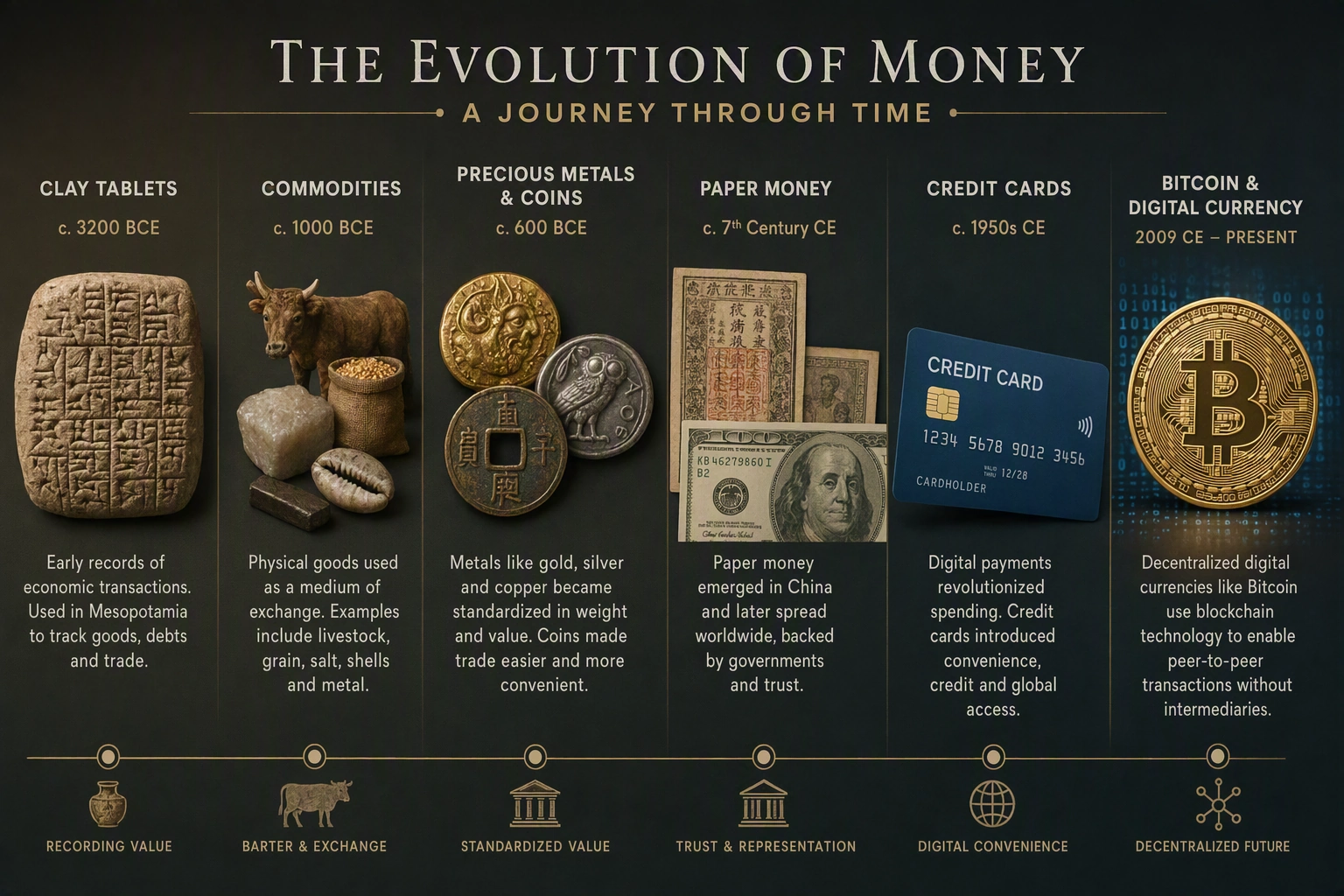
Have you ever stopped to think about what is actually in your wallet or bank account?
Money does not exist naturally. It is a social phenomenon that emerged out of necessity to communicate value within human civilization. It is a shared fiction created to facilitate trade, eliminate the inefficiencies of barter, and act as a universal medium of exchange.
But money has not been static. It has evolved over time. To understand where our financial system is heading, we have to look at how it began and why every monetary system in history has eventually reached a breaking point.
Money is an abstract form of energy – Jack Mallers
The History of Money: 5 Evolutionary Steps
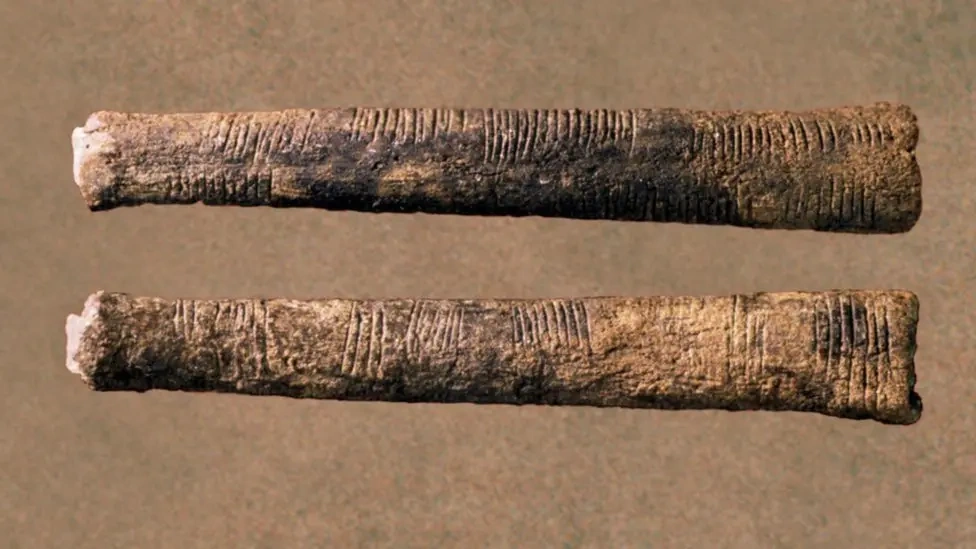
The 20,000-year-old Ishango Bone appears to show matched tally marks used for correspondence counting.
1. Clay Tablets (Mesopotamia)
The clay tablets of ancient Mesopotamia represent one of the earliest forms of credit and banking systems.
The article and radio segment “How the world’s first accountants counted on cuneiform” by economist Tim Harford provides an excellent, accessible summary of how the clay tablets functioned as legal contracts and receipts. Available to read on BBC News.
Summary: Why Written Clay Ledgers Shifted to Physical Commodity Money
- The Cross-Border Trust Deficit: Within Mesopotamian city-states, centralized institutions like the temple and palace guaranteed the value of debts recorded on clay tablets. However, as trade expanded into international networks, foreign merchants lacked trust in the administrative decrees of a foreign ruler. According to historical economic research hosted on ResearchGate, this lack of institutional trust forced a transition to universally accepted commodities—primarily silver—which possessed inherent value across borders.
- The Demand for Frictionless, Immediate Liquidity: Settling transactions with clay tablets required a cumbersome bureaucratic process involving scribes, legal witnesses, and physical archive verification. As mobile merchant routes grew, traders needed to finalize exchanges rapidly without institutional red tape. Verified by historical analyses on the University of Texas archives, shifting to commodity money allowed transactions to be settled instantly on-site by simply weighing metals on a scale.
- Logistical Fragility and Scalability: While baked clay provided an excellent, permanent record for static temple granaries, the tablets were heavy, bulky, and structurally fragile. Curatorial research from The Metropolitan Museum of Art demonstrates that transporting hundreds of delicate legal loan contracts on long caravan routes was highly impractical. Precious metals solved this by concentrating vast economic value into a durable, lightweight, and highly portable physical form.
2. Commodity Money (Shells, Tobacco, Salt)

Sea shells as money
Ancient economies needed to trade outside the control of local palace bookkeepers. They also needed to trade with different cultures that did not share their written language. To do this, societies stopped writing debts on clay tablets. Instead, they began using commodity money. This meant people paid for things using real, physical objects that everyone valued.
“Research in economic history and archaeology shows that human societies used commodity money long before coins were invented. This includes studies on the Ancient Near East by the Institute for the Study of Ancient Cultures (ISAC). Prominent examples of these early currencies include grain and cattle in Mesopotamia, cowrie shells in China and Africa (Fauvelle, 2024), and salt in the Mediterranean, which inspired the Roman word salarium (salary).”
Why Commodity Money Failed – and the Rise of Precious Metals
Everyday items like shells, salt, and grain helped people trade without messy paperwork. However, these items had major physical flaws. They could not support growing, long-distance trade networks.
Historical economic papers on ResearchGate show that these early forms of money failed for three big reasons:
- They Ruined Easily: Grain rots or gets eaten by bugs, tobacco gets moldy, and salt melts in the rain or on wet ships. True money must store value safely for a long time.
- They Could Not Be Cut Up: If you cut a cowrie shell or a cow in half, you destroy its value.
- They Were Too Heavy: Moving huge loads of grain or salt across dangerous roads was costly and required too much work. The risk of theft was also very high compared to what the goods were worth.
Precious metals like silver and gold fixed all these problems. Studies by the University of Texas at Austin show that metals blended the best parts of physical money with lasting strength. Metals never rot, can be melted and cut into exact small pieces (like chopped silver) without losing value, and they pack huge value into a very small size. This silver and gold standard paved the way for the first stamped metal coins around 600 BCE.
3. Metallic Money (Gold & Silver)
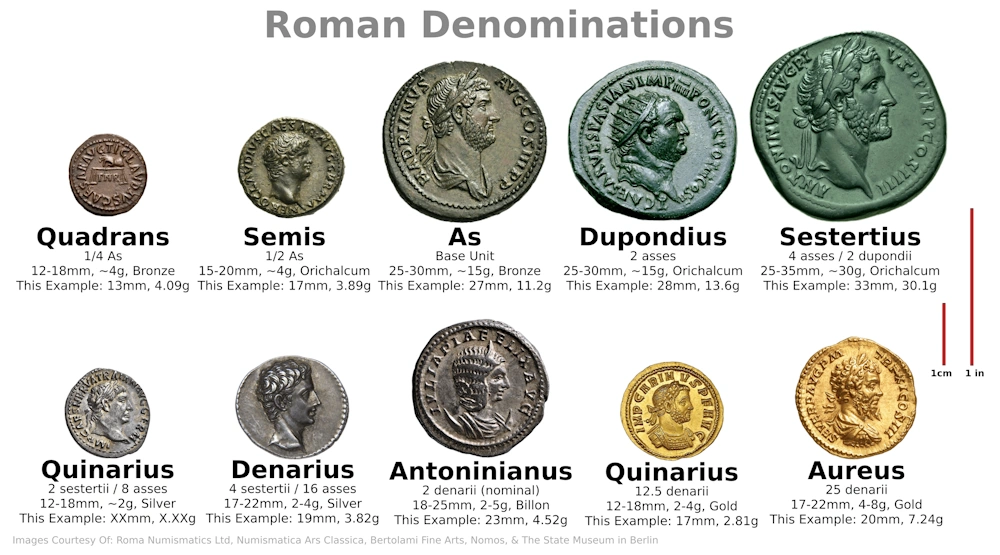
Roman currency for most of Roman history consisted of gold, silver, bronze, orichalcum (brass), and copper coinage.
Gold and silver naturally became dominant because they possess unique physical properties:
- they are durable (Gold does not rust, tarnish, or corrode. Silver resists most corrosion, though it does tarnish when exposed to sulfur in the air)
- recognizable (relatively easy to verify. However, there are still ways to make fake coins or
- divisible
- scarce – hard to find and mine more of it (Its vary hard to inflate the supply without a cost associating to it)
- portable – hold high value relative to their weight
At first, people traded raw chunks of precious metals that had to be weighed during every single transaction. Soon, governments realized they could standardize the weight and purity by stamping them—giving birth to coinage. The first coins are believed to have been minted in Lydia (modern-day Turkey) around 600 BC.
Precious Metals Take Control: As everyday commodity money (like shells and grain) failed due to rotting or being too heavy to carry, merchants turned to silver and gold. According to The Oriental Institute at the University of Chicago, silver weights became the main way to trade across borders because metals are indestructible and relatively easy to melt down into small pieces. Around 600 BCE, the Kingdom of Lydia took this a step further by stamping metal into the world’s first official coins, which stopped the need to weigh the metal during every single trade.
The Problem with Two Metals: For centuries, most countries used a bimetallic standard, meaning they used both gold and silver as legal money at a fixed rate. However, this caused constant economic issues because the market value of gold and silver shifted over time. As explained in research hosted on ResearchGate, a rule called Gresham’s Law took effect: people hoarded the metal that was worth more on the open market and spent the cheaper one, making it very hard for governments to keep both metals in daily circulation.
The Arrival of the Gold Standard: To fix this instability, Great Britain formally adopted the gold standard in 1819, linking its paper money directly to a fixed weight of gold. Historical timelines on Wikipedia show that other major powers like Germany, France, and the United States followed in the 1870s. This created the Classical Gold Standard, a global system where anyone could hand in paper cash to a bank and get an exact amount of physical gold in return, keeping international exchange rates perfectly stable until World War I.
4. The Gold Standard (Paper Backed by Gold)
The Telegraph Speed Problem
In 1866, the first transatlantic telegraph cable was laid, connecting New York and London. Suddenly, financial news and stock prices traveled across the ocean in seconds instead of taking ten days by steamship. However, physical gold and silver still had to move slowly on ships. This created a huge gap: information moved at the speed of electricity, but physical metal moved at the speed of a boat.
How This Created the Gold Standard
Because moving heavy metal was too slow for the new, fast telegraph markets, countries had to stop trading with actual physical gold. Instead, they kept the gold locked safely in bank vaults and traded using paper bank notes and telegraph messages. To make sure merchants in different countries trusted these fast paper and telegraph transactions, governments tied the value of their paper cash directly to gold. This international agreement is what we call the Classical Gold Standard. The telegraph did not destroy gold; it forced gold to become a silent anchor hidden in vaults while paper and signals did the running.
Why the Gold Standard Eventually Failed
Gold did not fail because of the telegraph, but it did fail later because of a new problem: governments could not print physical gold.
- During World War I and the Great Depression, governments desperately needed to spend money fast to pay for wars and fix their economies.
- Under the gold standard, you could only print as much paper cash as you had gold in your vault.
- Since they could not mine gold fast enough to match the speed of their growing financial needs, countries abandoned the gold standard entirely.
This led to our modern system of fiat money, where cash is not backed by gold or silver at all, but only by digital data and trust in the government.
The final blow came in 1971, when US President Richard Nixon officially announced that the US dollar would no longer be exchangeable for gold.
5. Paper Money & The Birth of Modern Banking
Modern banking started with early goldsmiths who kept people’s physical gold safe in vaults. They gave customers paper receipts for their gold. Soon, the goldsmiths noticed that people rarely came to get their actual gold all at the same time. Seeing an opportunity, they began printing and lending out far more paper receipts than the real gold they held.
By lending these extra receipts and charging interest, they created money out of thin air. As long as people trusted the paper notes, the system worked. However, it was risky. If too many people demanded their physical gold at once, a “bank run” happened, and the system crashed. Historical records from the Federal Reserve Bank of Richmond show that this clever but fragile practice became the foundation for our modern fractional reserve banking system.
Fiat Money (The Modern Era)
Today, governments and central banks use fiat money, which is paper or digital cash not backed by any gold at all. This system gives governments huge advantages. They can create new money out of nothing to pay for state projects, handle national crises, and control the economy by changing interest rates. This grants them immense economic power.
However, as explained in monetary histories by The Federal Reserve Board, this unlimited power causes three major downsides:
- Constant Inflation: Because banks can print endless amounts of cash, fiat currencies continuously lose their buying power over time.
- Boom and Bust Cycles: When central banks flood the market with cheap money, they accidentally create economic bubbles that eventually pop and cause recessions.
- A Hidden Tax: Because your cash buys less every year, inflation acts as a silent penalty that slowly destroys the value of your personal savings.
Why do monetary systems fail?
Historically, every monetary system falls due to one of two reasons:
- A Collapse in Trust: People stop believing in the promises of the issuer.
- Technological Obsolescence: A new, more efficient technology makes the old medium of exchange irrelevant.
The Austrian School Definition of Money
According to Austrian economics, money is defined simply as the most marketable and universal medium of exchange.
To function effectively, money must serve three core functions.
- A Medium of Exchange (Easy to trade)
- A Store of Value (Preserves purchasing power over time)
- A Unit of Account (A standard measure for pricing)
To be able to serve all three functions, money must posess five essential properties:
- Durable: It must last over time without degrading or rotting.
- Divisible: It must be easily divided into smaller fractions for everyday purchases.
- Recognizable: It must be easy for anyone to identify and verify as authentic.
- Portable: It must be easy to carry, move, and transport across distances.
- Scarce: It must be rare and exceptionally difficult or expensive to mass-produce.
Whichever asset does this best eventually wins the confidence of the market.
True money is acquired and held solely to be exchanged for something else in the future. It is not saved to be consumed or used in industry.
When looking at the demand for any asset, we must weigh its current utility (e.g., you are thirsty, so you value water right now) against its future saleability (the certainty that you can exchange it for whatever you want tomorrow).
Money naturally evolves from the commodity that possesses the highest future saleability combined with the lowest immediate industrial utility. – Robert Breedlove
Historically, gold best fit this description. While it has some industrial and jewelry utility (about 20%), roughly 80% of its value comes purely from its role as a premium store of value over time. However, gold fails in portabiliy against fiat money since you can transfer fiat money digital.