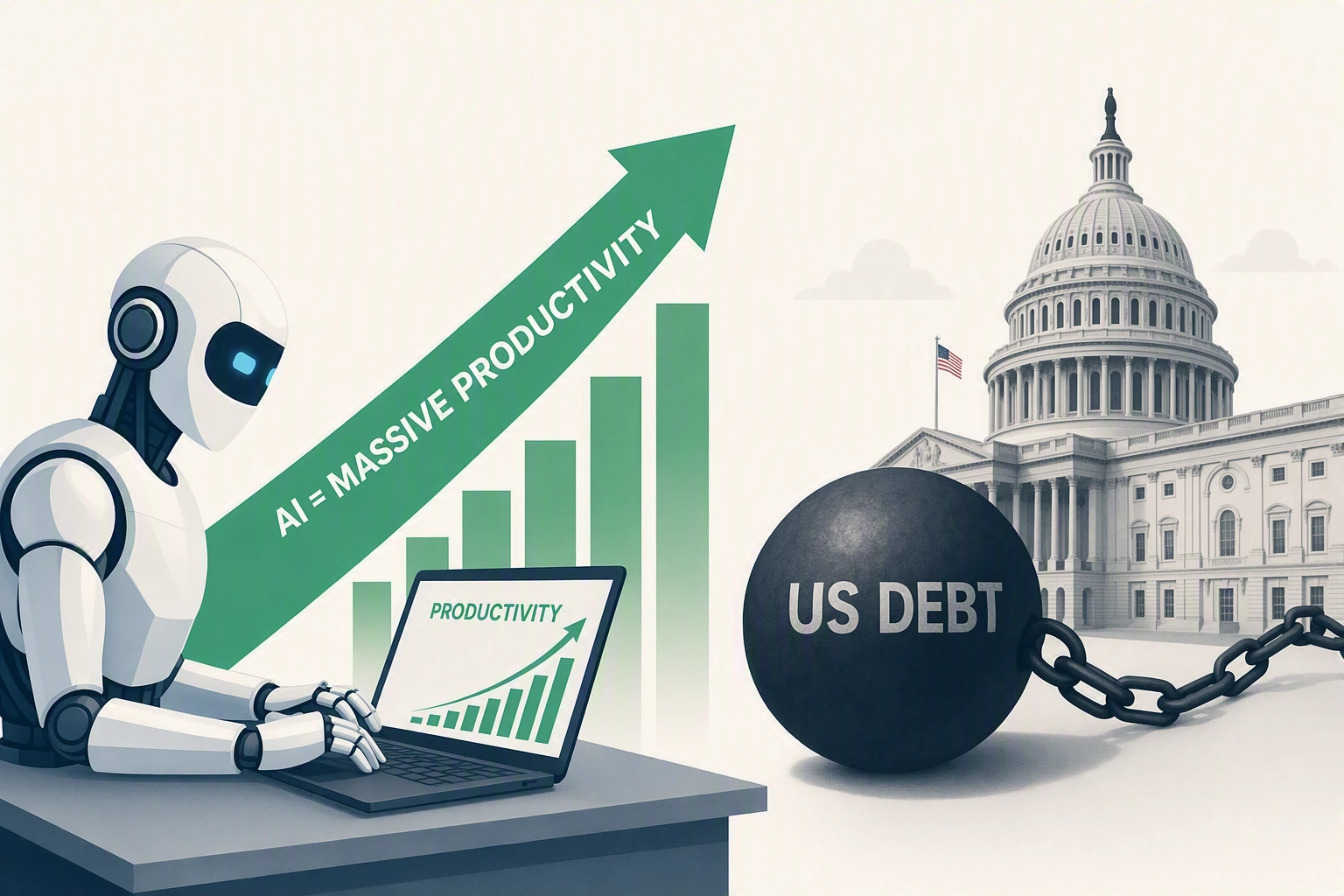
This post examines a critical structural blind spot in contemporary macroeconomic projections: the hyper-deflationary nature of Artificial Intelligence (AI) and its destructive impact on nominal tax bases.
While mainstream economic models often predict that an AI-driven productivity boom will allow the United States to “grow out of its national debt,” these models fundamentally misunderstand the mechanics of sovereign debt servicing.
Sovereign debt is fixed in nominal dollars. The US fiscal engine relies almost entirely on taxing highly compensated human labor (income and payroll taxes). If AI achieves massive cognitive substitution—for example, replacing a lawyer earning $1,000,000 per year with a software license costing $100 per year—the nominal economic footprint of that sector collapses. Even if the real economic output increases, the nominal revenue required to service the national debt evaporates. This analysis models the structural transition from labor to capital, the breakdown of the federal tax engine, and the resulting debt-deflation spiral.
The current system is inflationary and the natural state of the free market is deflationary. -Jeff Booth
The debt is insolvent, and it always has been. A broken system can not be solved within the system, but have to be replaced by a functional system.
1. Introduction: The Conventional Growth Myth vs. The Deflationary Reality
For decades, economists and policymakers have debated the sustainability of the United States’ national debt. The traditional playbook for managing high debt-to-GDP ratios without outright default or severe austerity involves “growing out of the debt.” By increasing productivity, the economy expands, broadening the tax base and generating enough nominal revenue to outpace interest payments.
With the advent of generative AI and large language models, this playbook has been updated by tech advocates who forecast an exponential productivity boom. They argue that if AI can automate routine cognitive and physical tasks, corporate output will skyrocket, creating a fiscal surplus.
This optimistic framework suffers from a catastrophic conceptual flaw: it conflates physical or digital productivity with nominal fiscal health. AI represents a profound supply-side shock that collapses production costs. In a competitive market, collapsing production costs lead directly to collapsing prices for goods and services. While this increases “real” wealth in terms of purchasing power per unit, it exerts a massive deflationary pull on nominal values.
The US government does not pay its debts in “real productivity units”; it pays its debts in nominal US dollars, which are collected via percentages of nominal transactions (wages, corporate profits, and retail sales). If AI collapses the nominal value of these transactions, the fiscal engine stalls. The core barrier to paying off the debt is not a lack of output, but rather the structural deflationary destruction of the federal tax architecture.
2. The Mechanics of AI Deflation: The Microeconomic Transformation
To understand the systemic fiscal crisis, one must look at the microeconomic microfoundations of AI substitution. Consider a highly skilled corporate lawyer in New York earning \$1,000,000 per year. This individual sits within a specific tax bracket, paying roughly 37% in federal income taxes, alongside state, local, and payroll taxes. Their consumption patterns—buying real estate, dining out, purchasing luxury goods—velocity-stimulate other sectors of the economy, generating further sales and corporate taxes.
Now, consider the deployment of an advanced AI legal agent capable of performing document review, contract drafting, and case law analysis with greater accuracy and speed than the human lawyer. The operating cost of this AI software is roughly \$100 per year in cloud computing resources.
When a corporation replaces the human lawyer with the AI agent, the immediate microeconomic effects are:
1. Cost Elimination: The corporation saves \$999,900 in operating expenses.
2. Labor Income Annihilation: The \$1,000,000 nominal wage base vanishes from the labor market.
3. Price Deflation: Under competitive pressures, the corporation lowers the price of its legal services to consumers or clients, passing on the savings.
If this phenomenon occurs in isolation, it represents a standard story of creative destruction. However, AI scales at near-zero marginal cost. Unlike historical industrial shifts—where displaced agricultural workers transitioned to manufacturing over decades—AI can be deployed globally and instantaneously via software updates.
What happens when this microeconomic event scales globally? If 50% of all lawyers, legal assistants, and compliance officers are replaced, billions of dollars in nominal labor income evaporate overnight.
The same dynamic applies to blue-collar and operational roles. If 50% of all taxi, delivery, and truck drivers are replaced by autonomous driving software, millions of working-class livelihoods are stripped of nominal wage value. Because AI can target both high-wage cognitive tasks and low-wage manual tasks simultaneously, it creates a dual-front deflationary wave that attacks the entire spectrum of human labor.
3. The Collapse of the Federal Revenue Engine
The United States government relies almost entirely on taxes tied to human labor and localized consumption. According to data from the Internal Revenue Service (IRS) and the Congressional Budget Office (CBO), individual income taxes and payroll taxes (Social Security and Medicare) consistently comprise over 80% of total federal revenues. Corporate income taxes, by contrast, generally account for less than 10% to 15%.
The math behind this revenue engine is highly vulnerable to AI displacement:
“`
[Human Employee: $1,000,000/yr] —> Generates ~37% Income Tax + Payroll Taxes + High Velocity Local Spending
|
(AI Substitution)
v
[AI Software: $100/yr] ————-> Generates 0% Income Tax + 0% Payroll Taxes + Static Cloud Cost
“`
When 50% of the workforce across key knowledge and service industries is replaced by software costing pennies on the dollar, the individual income tax base undergoes a structural collapse. A \$100 software license does not pay income tax, nor does it contribute 6.2% to Social Security or 1.45% to Medicare.
Optimists argue that the \$999,900 saved by corporations transitions directly into corporate profits, which can then be taxed via the corporate income tax code to make up the difference. This argument fails for three primary reasons:
A. The Corporate Tax Rate Gap
The statutory federal corporate tax rate in the US stands at 21%, which is significantly lower than the top marginal individual income tax rate of 37%. In practice, due to deductions, R&D credits, and international tax planning, the *effective* corporate tax rate for major technology and automated firms is frequently in the single digits or low teens. Shifting income from high-tax labor to lower-tax corporate capital automatically results in a massive net loss for the US Treasury.
B. Global Profit Shifting
Software and AI algorithms are intangible assets. Unlike a physical factory or a human worker tied to a specific geographic location, an AI legal agent or autonomous driving algorithm can easily have its intellectual property (IP) assigned to low-tax jurisdictions or offshore tax havens (such as Ireland, the Cayman Islands, or Bermuda). When a US company utilizes AI to eliminate American workers, the resulting corporate profits can be easily shifted overseas through transfer pricing mechanisms, leaving the US Treasury with virtually nothing to tax.
C. Competitive Price Eradication
In highly competitive markets, companies do not simply sit on excess profits generated by automation. Instead, they engage in price wars to capture market share. If all major logistics firms automate 50% of their driver workforce, the cost of shipping drops to near zero.
As prices collapse, the massive corporate windfall disappears, replaced by massive consumer price deflation. While consumers benefit from cheaper goods, the *nominal* size of the market shrinks dramatically. A smaller nominal market means lower nominal revenues, lower nominal corporate profits, and consequently, lower tax receipts.
4. The Debt-Service Trap in a Deflationary Environment
The fundamental metric used by economists, rating agencies, and bond markets to evaluate the fiscal health of a nation is the **Debt-to-GDP Ratio**.
$$\text{Debt-to-GDP Ratio} = \frac{\text{Nominal Debt}}{\text{Nominal GDP}}$$
Crucially, both variables in this equation behave differently under the influence of AI deflation:
The Numerator (Nominal Debt): The national debt is a fixed legal obligation. If the US government owes \$35 trillion, that number does not shrink when prices or wages fall. Interest payments (coupons) on outstanding Treasury bonds are entirely locked in based on nominal agreements.
The Denominator (Nominal GDP): Nominal GDP is a function of real output multiplied by price levels ($Y \times P$). If real output ($Y$) increases by 10% due to AI, but prices and nominal wages ($P$) collapse by 20% due to hyper-deflationary cost structures, **Nominal GDP decreases**.
When Nominal GDP shrinks while Nominal Debt remains fixed or continues to grow via compounding interest, the Debt-to-GDP ratio accelerates upward. This is the classic “debt deflation” spiral first detailed by economist Irving Fisher during the Great Depression. In a deflationary economy, the real burden of debt increases because each dollar owed becomes harder to acquire. The government must collect revenues from an ever-shrinking pool of nominal transactions to pay off a mountain of debt that never shrinks.
Furthermore, as tax revenues plunge due to the displacement of human workers, the government is forced to run even larger annual budget deficits simply to keep the lights on and pay interest on its existing debt. This requires issuing more Treasury bonds, driving the nominal debt higher at the exact moment the revenue base is disintegrating.
5. The Velocity of Money and the Aggravation of Disparity
Monetary theory dictates that nominal GDP is also a product of the money supply ($M$) and the velocity of money ($V$), which measures how fast a dollar circulates through the economy ($MV = PQ$). AI structurally suppresses the velocity of money by exacerbating wealth inequality to an extreme degree.
Human workers must spend a large percentage of their income immediately on survival needs—rent, food, healthcare, transport, and leisure. This high marginal propensity to consume ensures that money circulates rapidly through local economies, generating sales tax, business revenue, and secondary employment.
When income is redirected from human workers to capital owners (the tech conglomerates and shareholders who own the AI models), the velocity of money stalls. Wealth becomes concentrated in the hands of a small number of billionaires and institutional funds. These entities have a very low marginal propensity to consume; instead of spending their marginal dollars back into the real economy, they hoard capital in passive financial assets, real estate, or sovereign debt instruments.
With money locked up in capital reserves rather than circulating through wages, the velocity of money collapses. This further depresses nominal prices and starves the government of transactional tax revenues. The economy enters a state of persistent secular stagnation, making it mathematically impossible to generate the nominal growth needed to outrun the national debt.
6. Failed Mitigations and Institutional Roadblocks
To avert this deflationary crisis, several counter-measures are frequently proposed by technologists and policymakers. However, each of these solutions carries severe structural limitations that render them ineffective at solving the sovereign debt crisis.
A. Universal Basic Income (UBI) Funded by AI Taxes
A common proposal is to levy a “robot tax” or an “AI tax” to fund a Universal Basic Income for displaced workers. While this may cushion the social blow of mass unemployment, it does nothing to pay off the national debt.
If the government taxes AI profits at a high rate just to redistribute those dollars to citizens via UBI so they can pay basic sales taxes, the government is running a closed-loop survival system. The UBI payments represent a massive new entitlement program—potentially costing trillions of dollars per year—which would dwarf existing spending on Social Security. Instead of paying down the existing \$35+ trillion national debt, the government would be dramatically expanding its balance sheet just to prevent social collapse, adding to the debt burden.
B. Central Bank Inflation Engineering (Massive QE)
In a deflationary crisis, the Federal Reserve would likely step in by slashing interest rates to zero and launching massive Quantitative Easing (QE) programs—essentially printing money to artificially engineer inflation.
However, when deflation is driven by structural supply-side technology (i.e., the cost of production is legitimately close to zero), printing money into the financial system does not easily create consumer price inflation. Instead, it creates **asset price inflation**—driving up the price of stocks, luxury real estate, and tech monopolies while everyday goods and services remain cheap. This does not help the average tax base, but it does heavily distort financial markets and increases the risk of systemic financial instability.
C. The Entitlement Indexing Conflict
Advocates of the growth narrative point out that if the US experiences a supply-side AI boom, the cost of living drops, meaning the government could theoretically spend less on public services. However, major US entitlements are politically and structurally rigid. Social Security benefits are tied to historical wage indexes and Consumer Price Indexes (CPI).
If the economy undergoes a sudden, messy transition where millions are displaced before indexation formulas adjust, or if political pressure forces the government to maintain payouts to an aging, voting population, spending cannot easily be wound down. Furthermore, if AI healthcare innovations increase human longevity, the government will face decades of additional Medicare payouts, compounding the debt problem regardless of how cheap the underlying medical software becomes.
7. Comparative Analysis: Industrial Revolution vs. The AI Paradig
To fully appreciate why this deflationary threat is unique, it is useful to contrast the AI transition with prior technological shifts, such as the Industrial Revolution or the Digital Revolution of the late 20th century.