The question of whether the Bitcoin price in USD will increase forever is no longer just a speculative debate for internet hobbyists or Bitcoin maximalists.
It has become a foundational question of macroeconomic theory. When looking at the nominal price of Bitcoin (BTC) expressed in United States Dollars (USD), the short answer is yes, it is structurally designed to rise indefinitely.
However, this phenomenon is only halfway understood by looking at Bitcoin itself. To understand why Bitcoin will inevitably march toward infinity in dollar terms, we must examine both sides of the trading pair: the collapse of the denominator (USD) due to systemic debt, and the absolute scarcity of the numerator (BTC).
This long-form analysis will break down the mechanics of the global debt trap, the nature of monetary inflation, the revolutionary mechanics of Bitcoin’s scarcity, and why—in the long run—everything else humans can produce will mathematically depreciate when priced in Bitcoin.
In this article we refer to the USD but all fiat currencies are fundamentaaly the same and can be interchanged. However, USD tends to be the best performing fiat currency over the last 50 years.
1. The Denominator Problem: Why the US Dollar is Programmed to Devalue
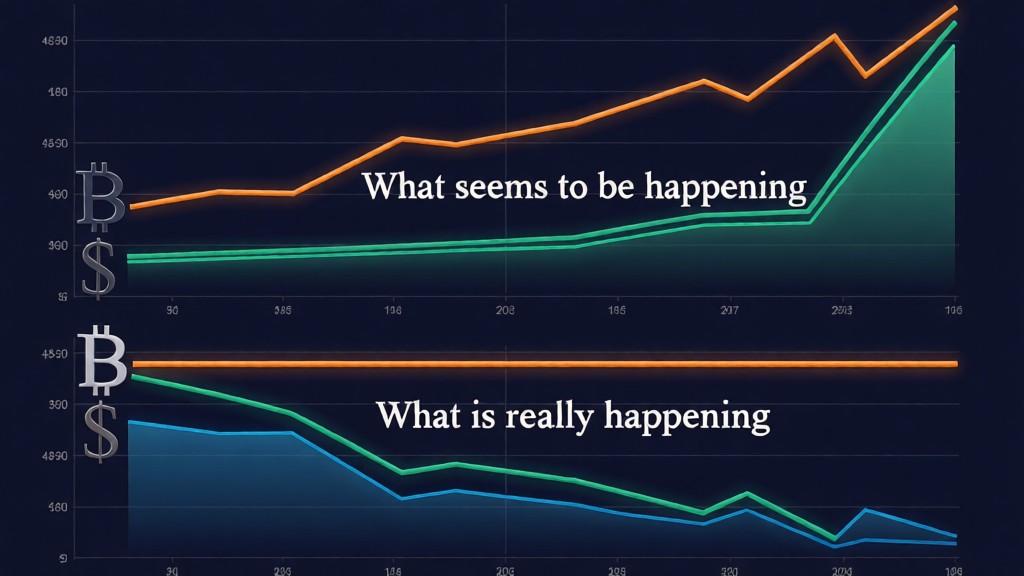
To predict the future price of Bitcoin, one must first understand the future of the US Dollar. When we say “Bitcoin is going up,” we are often actually saying “the dollar is going down.”
Price of Bitcoin = Bitcoin (Absolute Scarcity) / US Dollar (Infinite Expansion)
The United States Dollar is a fiat currency, backed by nothing but the faith and credit of the US government. Since the decoupling of the dollar from gold in 1971, the supply of USD has expanded drastically. This expansion is not accidental; it is a structural requirement of a financial system built entirely on debt.
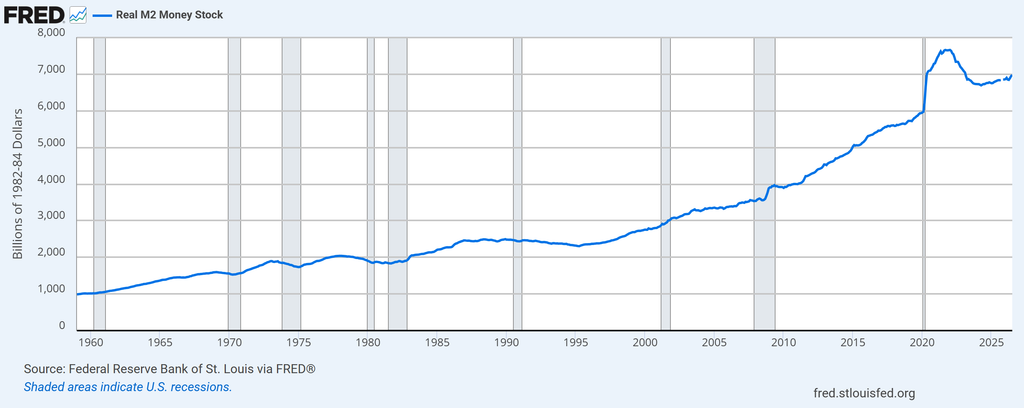
USD M2 chart from the Federal reserve.
The Sovereign Debt Trap
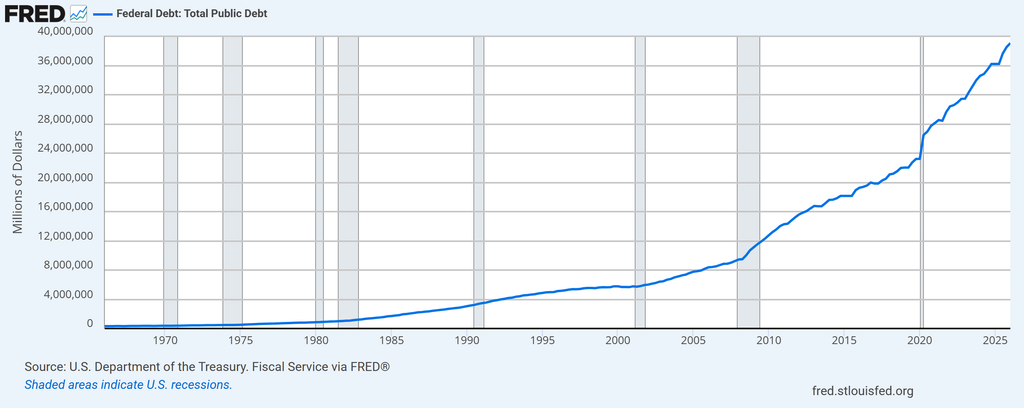
The United States national debt has surpassed unsustainable thresholds, growing at a velocity that far outpaces economic productivity. When a government incurs massive debt, it faces a mathematical reality: it cannot default explicitly without collapsing the global financial infrastructure, and it cannot raise taxes enough to pay it off without destroying the domestic economy.
The only remaining political and economic escape hatch is monetary debasement, often referred to as “printing money” or quantitative easing. The Federal Reserve expands its balance sheet to purchase government bonds, effectively creating new dollars out of thin air to fund the debt.
We describe how the debt is insolvent and not even the most efficient AI can solve it because AI, as all economic activity, are deflationary by nature.
Exponential Inflation as a Feature, Not a Bug
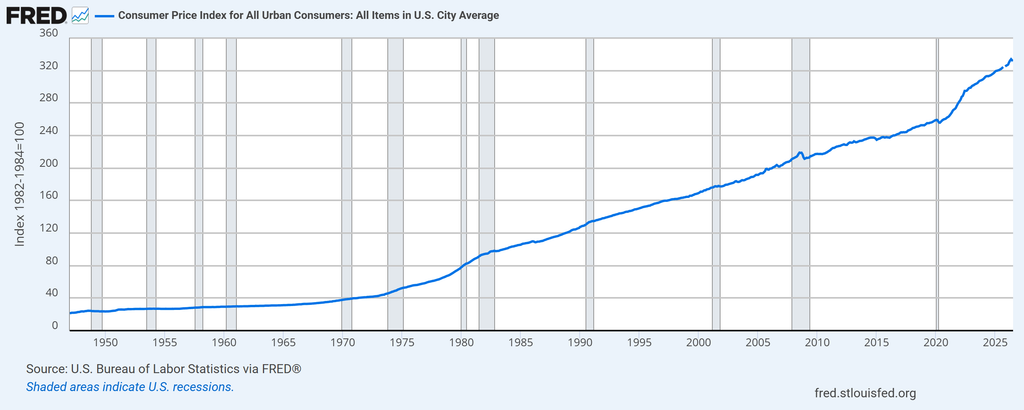
This continuous injection of currency dilutes the purchasing power of every dollar already in circulation. This is the definition of inflation. While mainstream economics often defines inflation as a general rise in consumer prices, the root cause is the expansion of the money supply.
Because the interest on the existing debt requires the creation of even more debt to pay it off, the money supply must expand exponentially. If the printing presses stop, the debt system experiences an immediate, catastrophic deflationary collapse. Therefore, the monetary authorities are trapped: they must inflate the dollar forever. Consequently, any asset that cannot be arbitrarily duplicated will see its price rise in USD terms forever simply because the dollar itself is falling in value.
This is why stocks, real estate and any other asset or commodity has seen rising prices. They are simply growing the supply in a slower pace than the USD itself.
In the graph below, you can see the CPI, consumer price index in the US.
2. The Stock-to-Flow Model and Absolute Scarcity
While the dollar expands toward infinity, Bitcoin is anchored to an uncompromising mathematical reality: there will only ever be 21 million Bitcoins.
To understand why this makes Bitcoin fundamentally different from every other asset class in human history, we must look at the concept of Stock-to-Flow (S2F).
Understanding Stock-to-Flow
The Stock-to-Flow ratio is a metric traditionally used to measure the scarcity of commodities like gold and silver.
- Stock: The existing supply of an asset that has already been mined or produced.
- Flow: The annual production or amount of new asset entering the market over a specific period.
A high Stock-to-Flow ratio means that it would take many years of current production to replicate the existing stock, making the asset highly scarce and resilient to supply shocks.
Historically, gold held the highest Stock-to-Flow ratio among all physical assets (typically hovering around 60). This meant it would take roughly 60 years of continuous mining to double the world’s existing gold supply (1.8% inflation). This high ratio is exactly why humanity selected gold as money(over silver, cupper or any other precious metal or commodity) for thousands of years; it resisted debasement because a sudden spike in demand could not easily result in a massive flood of new supply.
Bitcoin’s Programmable Scarcity
Bitcoin completely rewrote the rules of the Stock-to-Flow model. Unlike gold, where a higher market price incentivizes miners to dig deeper and find more gold reserves, Bitcoin’s supply schedule is hardcoded into its protocol and completely unyielding to demand.
Every four years, an event known as the “Halving” occurs. The block reward given to Bitcoin miners—which represents the “Flow” of new Bitcoins into existence—is cut exactly in half.
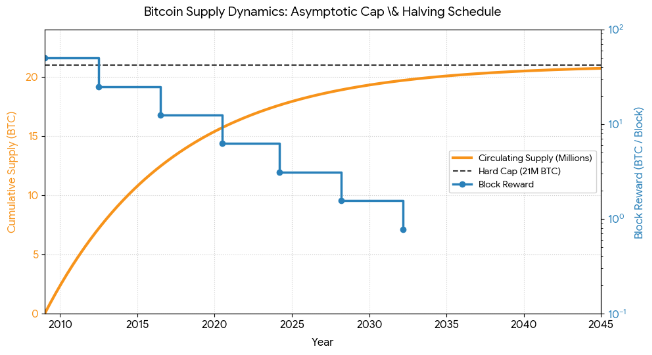
As the flow drops every four years, Bitcoin’s Stock-to-Flow ratio doubles. Following recent halving events, Bitcoin’s Stock-to-Flow ratio surpassed that of gold, making it legally and mathematically the scarcest monetary asset ever known to civilization.
No matter how high the price of Bitcoin climbs, no matter how many supercomputers join the mining network, and no matter how much energy is expended, the flow cannot be increased as long as it members agree to not change the rules. The protocol automatically adjusts its mining difficulty every two weeks to ensure blocks are found roughly every ten minutes, keeping the supply trajectory perfectly fixed.
3. The Only Asset Humans Cannot Produce More Of
Human history is a story of overcoming scarcity through ingenuity. Whenever an asset or commodity becomes incredibly valuable, human beings find a way to produce more of it.
The Elasticity of Human Supply
Consider any traditional asset or commodity:
- Real Estate: When land prices in metropolitan areas skyrocket, developers build vertically, creating luxury high-rises out of thin air. They reclaim land from the sea, or urban sprawl expands outward.
- Gold and Precious Metals: If gold spikes to $10,000 an ounce, previously unprofitable mines become viable. Ocean floor mining, deep-crust drilling, and eventually asteroid mining become economically feasible. The supply expands to meet the demand.
- Fiat Currency: As established, central banks can create trillions of dollars, euros, or yen with a single stroke of a computer key.
- Art and Collectibles: Even the rarest physical art has an elastic supply of substitutes. If vintage paintings become too expensive, the market pivots to contemporary art, digital collectibles, or cultural alternatives.
Bitcoin stands completely alone as the only asset in human history where the supply is entirely inelastic. It is the single thing human beings have mutually agreed—through a decentralized, unalterable consensus mechanism—to never produce more of.
The Psychological Paradigm Shift
Because humans are hardwired to live in a world where supply reacts to demand, grasping absolute scarcity requires a major mental shift.
If the global demand for Bitcoin increases tenfold, the supply cannot respond by expanding. The entire weight of that increased demand must express itself solely through a massive adjustment in price. This creates a continuous upward vacuum on its purchasing power relative to every single asset whose supply can be increased by human labor.
4. The Grand Flips: Everything Else Deflates in Bitcoin Terms
Because Bitcoin has a fixed supply while everything else has an expanding supply, a fascinating economic inversion occurs over time. Instead of looking at Bitcoin through the distorted lens of an inflating US Dollar, we must look at the world through the lens of Bitcoin.
When you price the world in Bitcoin, you realize that Bitcoin is not actually rising; rather, the cost of everything else is collapsing. This introduces a state of structural deflation for goods, services, and assets when measured in BTC terms.
Real Estate, Stocks, and Commodities in BTC
Let us look at how traditional stores of value perform when measured against Bitcoin over long horizons. While a house in a major city or a share of an index fund may look like it is consistently gaining value in US Dollars, that gains is largely an illusion caused by the devaluation of the dollar.
When priced in Bitcoin, the trajectory changes dramatically:
- Housing: A home that cost hundreds of Bitcoins a decade ago can now be purchased for just a fraction of a single Bitcoin or a few whole coins. Because architects can build more houses, but developers cannot build more Bitcoin, real estate consistently loses value relative to BTC.
- Technology: Technology naturally deflates due to efficiency gains (Moore’s Law). Computer chips become faster, televisions become cheaper, and manufacturing becomes automated. When you combine the natural deflation of technology with the absolute scarcity of Bitcoin, the price of tech in BTC terms drops precipitously.
- Commodities: Oil, wheat, copper, and steel require human labor and machinery to extract. As our technology improves, we extract them more efficiently. Because we can always harvest more commodities but can never harvest more Bitcoin, the exchange rate of commodities per Bitcoin will continuously trend downward over multi-decade cycles.
| Asset Class | Priced in USD (Long-Term) | Priced in BTC (Long-Term) | Primary Driver |
|---|---|---|---|
| Fiat Currency | 📉 Declines naturally | 📉 Collapses to zero | Infinite printing to fund debt |
| Real Estate | 📈 Appears to rise | 📉 Decreases steadily | Land can be optimized/expanded |
| Commodities | 📈 Fluctuates upward | 📉 Drops systematically | Tech makes extraction more efficient |
| Bitcoin | 🚀 Increases forever | 🟩 Base Measure (1 BTC = 1 BTC) | Absolute mathematical scarcity |
Humanity has accidentally stumbled upon a perfect yardstick. For the first time, we have a ledger that cannot be manipulated, expanded, or corrupted. As a result, anything that requires human effort, capital, or raw materials to create will inevitably become cheaper over time when measured in Bitcoin.
5. The Path to Hyperbitcoinization and Beyond
If the theoretical foundation holds true—that the USD must inflate forever due to debt, and Bitcoin cannot expand due to its code—what does the future look like? The process of Bitcoin absorbing global wealth is often referred to as Hyperbitcoinization.
The Monetary Black Hole
Bitcoin acts as a monetary black hole. In a world where keeping your wealth in fiat currency guarantees a loss of purchasing power, and holding wealth in traditional assets carries maintenance costs, taxes, and supply dilution, capital naturally searches for the safest, most efficient vehicle for preservation.
As individuals, corporations, and eventually nation-states realize that Bitcoin is the ultimate tool for moving economic value through time and space without dilution, they convert their excess capital into BTC. This systematic migration of wealth creates a compounding loop:
- Debt increases, requiring more fiat money printing.
- Fiat currency loses purchasing power, driving people to seek hard assets.
- Capital flows into Bitcoin due to its superior Stock-to-Flow ratio.
- The Bitcoin price in USD rises, drawing more global attention and legitimacy.
- More people adopt BTC, accelerating the drain of liquidity out of traditional fiat systems.
Will the Inevitable Volatility Stop?
Critics often point to Bitcoin’s intense, cyclical price drops as evidence that it cannot serve as a reliable long-term store of value. However, this volatility is a natural feature of an asset undergoing price discovery in real-time.
Bitcoin went from having a market value of zero to becoming a multi-trillion-dollar global asset in less than two decades without a central bank, a military force, or a corporate marketing budget to protect it. It bootstrapped itself purely through open-source code and human self-interest.
As the total market capitalization of Bitcoin grows and it approaches the scale of global real estate and bond markets, the liquidity will become deep enough that the wild price swings will steadily dampen. The long-term trajectory, however, remains biased upward as long as the underlying fiat currencies continue their mathematical march toward debasement.
Conclusion: Turning Financial Reality Right-Side Up
Predicting that the Bitcoin price in USD will increase forever sounds like extreme hyperbole at first glance. Yet, when evaluated through the laws of mathematics, monetary history, and network effects, it reveals itself as an inevitability of our current financial architecture.
The US Dollar is structurally bound to an expanding mountain of debt that can only be sustained through perpetual inflation. Conversely, Bitcoin is bound by decentralized cryptographic consensus to absolute deflationary scarcity. When an infinitely expanding supply of currency chases a completely frozen supply of an asset, the nominal price of that asset can only move in one direction over time: upward.
Ultimately, Bitcoin forces us to change how we measure wealth. It shifts humanity away from a broken system where paper money loses value every year, forcing us to take wild risks in real estate and stock markets just to survive. By adopting an asset with an immutable, fixed supply, we enter a world where human productivity causes the price of everything else to fall. In the Bitcoin age, your time, labor, and savings finally retain their true value—forever.