
What is Bitcoin?
Bitcoin is a decentralized public ledger.
What Does Bitcoin Do?
Bitcoin, as a decentralized public ledger, allows anyone to transfer value by adding a ledger entry from anywhere in the world without intermediaries. This is secured through cryptographic verification rather than institutional or corporate trust.
Why is Bitcoin Revolutionary?
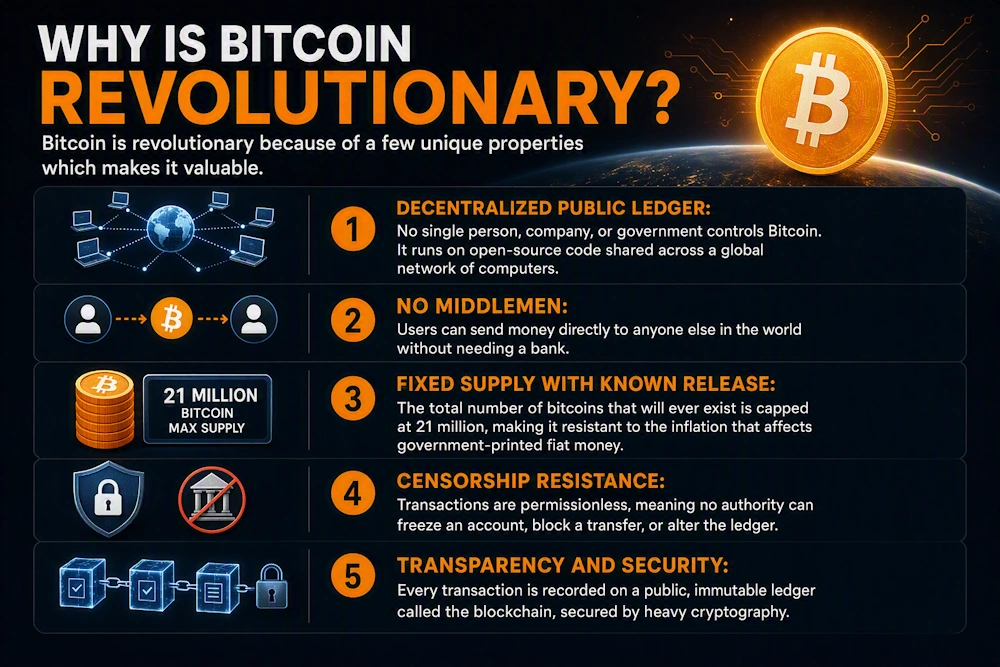
Bitcoin is revolutionary because of a few unique properties which makes it valuable.
- Decentralized public ledger: No single person, company, or government controls Bitcoin. It runs on open-source code shared across a global network of computers.
- No Middlemen: Users can send money directly to anyone else in the world without needing a bank.
- Fixed Supply with known release: The total number of bitcoins that will ever exist is capped at 21 million, making it resistant to the inflation that affects government-printed fiat money.
- Censorship Resistance: Transactions are permissionless, meaning no authority can freeze an account, block a transfer, or alter the ledger.
- Transparency and Security: Every transaction is recorded on a public, immutable ledger called the blockchain, secured by heavy cryptography.
How Bitcoin Works
Bitcoin works because of a corporation between Miners and Node Operators.
Bitcoin is digital money with no bank in charge. Instead, computers share a public record of payments called the blockchain.
A payment works like this:
- You send bitcoin. Your wallet announces a payment to the network.
- Nodes check it. They check that you’re allowed to spend those bitcoin and haven’t already spent them.
- Miners collect payments into a block. A block is like a new page in the payment record.
- Miners compete in a guessing contest. Their computers make lots of guesses, using electricity. A winning guess lets a miner propose the next block.
- Nodes check the proposed block. They accept it only if it follows Bitcoin’s rules. More blocks added afterward make the payment harder to reverse.
Why do miners bother? A miner whose block is accepted earns newly created bitcoin plus transaction fees.
The simple difference:
- Miners: Compete to add new pages.
- Nodes: Check the rules and keep copies of the record.
A miner cannot make an invalid payment valid because nodes would reject its block and the miner would have spent electric money on nothing.
“Bitcoin is the world’s first globally accessible electronic public money.”
Bitcoin VS Money functions and properties
From our article about what money is, we concluded the money should serve three functions and possess fiver properties to function effectively.
- A Medium of Exchange – Can you sell for Bitcoin and use Bitcoin to buy items. (This is not widely spread)
- A Store of Value – For 18 years Bitcoin has been the best store of value of any asset. At the current inflation rate, it has the lowest inflation and is the hardest money to create new of.
- A Unit of Account – Bitcoin is not a unit of account at the moment.
Bitcoin does fulfill all 5 desirable properties for a good money.
- Durable: Bitcoin doesn´t decay or rot.
- Divisible: Bitcoin is easily divisible into 1/100.000.000 (satoshis).
- Recognizable: Bitcoin can easily be verified by anyone on the public blockchain.
- Portable: Bitcoin is pure information and can be carried or send anywhere by anyone.
- Scarce: There will only be 21 million Bitcoin.
Decentralized Public vs. Centralized Payment Infrastructure
There is no single point of failure in a decentralized public infrastructre. Unlike a centralized infrastructure there are many ways a hacker can enter the system and cause many different type of damages.
Decentralized public infrastructure, such as Bitcoin, distributes the payment record across independent computers. Anyone can verify transactions against shared rules without relying on one bank or company. This reduces dependence on a single operator, but payments are generally irreversible, and wallets, exchanges, and users can still be hacked.
Centralized infrastructure, such as banks and payment processors, relies on trusted organizations to maintain records and authorize payments. It can offer fast processing, fraud support, and payment reversals, but concentrates sensitive data and operational control—creating valuable targets for attackers.
Examples of attacks and failures in centralized financial infrastructure
- Equifax breach, 2017: Initially reported as affecting 143 million Americans, the total was later revised to approximately 147 million. Exposed information included Social Security numbers, birth dates, and addresses. Equifax is a credit-reporting agency rather than a payment network, but the breach illustrates the risks of centralized financial identity databases.
- Fraudulent SWIFT instructions: Banks in Bangladesh, Vietnam, Ecuador, and Russia have experienced compromises involving fraudulent SWIFT instructions, although not every attempted transfer succeeded. Bangladesh Bank lost $81 million in 2016, an attack U.S. authorities later attributed to North Korean hackers. These incidents compromised participating banks—not SWIFT’s core network.
- Punjab National Bank fraud, disclosed in 2018: The bank initially reported approximately $1.8 billion in fraudulent transactions involving unauthorized guarantees transmitted through SWIFT. Employees allegedly colluded with outside businesses, bypassing internal controls. This was insider-enabled financial fraud, rather than an external hack.
- Target breach, 2013: Attackers entered through stolen vendor credentials and installed payment-terminal malware, exposing approximately 40 million payment-card accounts.
- Heartland breach, disclosed in 2009: Attackers compromised the payment processor’s systems, exposing data associated with approximately 130 million payment cards.
Bottom line: Centralized systems concentrate data and authority; decentralized systems distribute verification. Neither eliminates security risks, but they expose users to different kinds of failure.