Every day, billions of people exchange paper notes and digital numbers for food, housing, and clothing. We trust these pieces of paper or digital numbers to hold value. The current system is called fiat money, money created by government decree that is not backed by a physical commodity like gold or silver.
While fiat money makes daily shopping convenient, the system hiding behind your bank account is deeply flawed. At its core, the modern financial system is designed to transfer wealth away from ordinary citizens and into the hands of a select few.
To understand why fiat money is corrupt, we must look at how it is created, who gets it first, the global chaos it leaves behind, and the real-world humanitarian disasters it causes.
1. The Starting Point: What is Fiat Money?
For thousands of years, humans used commodity money. This was money made of things that had actual, physical value. Gold and silver emerged as the most popular choices as you can read more about in our article, What is money. You could not simply wish more gold into existence. It required hard work, tools, and mining to pull it out of the earth. Because gold was scarce, it held its value over time.
Fiat money is different. The word fiat is Latin for “let it be done.” Fiat money has value only because a government says it has value, and because citizens agree to accept it.
The Problem with No Backing
When money is tied to gold, a government can only spend what it actually has. If a government wants to build a new bridge or fund a war, it must raise taxes or borrow real gold. When a government switches to fiat money, those limits vanish.
- Infinite Supply: Fiat money can be printed or typed into a computer without limit.
- No Real Value: The paper in your wallet costs only pennies to print, but you must work hours to earn it.
- Broken Trust: Governments always face the temptation to print more money to solve their short-term financial problems.
This ability to create something out of nothing is the root cause of financial corruption. It sets off a chain reaction that alters the entire global economy.
2. Central Banks and the Magic Money Tree
Money does not grow on trees, but central banks have the next best thing: computers that can create money with a few strokes of a keyboard.
A central bank is a special institution that manages a country’s currency and monetary policy. Examples include the Federal Reserve in the United States and the European Central Bank in Europe. These institutions control the total supply of money.
[Central Bank Creates Digital Money]
              │
              ▼
[Buys Government Debt / Bonds]
              │
              ▼
[New Money Enters Commercial Banks]
How New Money is Issued
Central banks do not usually drop crates of cash from helicopters. Instead, they use a process called Open Market Operations.
- The Government Needs Cash: The government wants to spend more money than it collects in taxes, so it issues debt in the form of government bonds.
- The Central Bank Steps In: The central bank creates new, digital money out of thin air.
- The Swap: The central bank uses this brand-new money to buy the government bonds.
Through this process, the government gets immediate cash to spend, and the central bank gets an asset that pays interest. This trick allows governments to spend trillions of dollars without ever asking voters for permission or raising taxes.
The downside? Every new dollar created makes every existing dollar worth just a little bit less. The cascade downside? This only applies to people hold dollar and with no assets (Real estate, Stocks, Gold etc).
3. Fractional Reserve Banking: The Multiplier Lie
The illusion of money creation does not stop with the central bank. It continues at your local street-corner commercial bank through a system called fractional reserve banking.
Most people believe that when they deposit $1,000 into a bank account, the bank locks that money in a secure vault. In reality, the bank keeps only a tiny fraction of your money and lends out the rest to other people.
The Math of Making Money
Imagine the central bank sets a “reserve requirement” of 10%. This means a commercial bank only needs to keep 10% of its deposits in reserve and can safely lend out the remaining 90%.
- Step 1: You deposit $1,000 into Bank A.
- Step 2: Bank A keeps $100 (10%) and lends $900 to a person named John.
- Step 3: John uses that $900 to buy a used car. The car seller deposits the $900 into Bank B.
- Step 4: Bank B keeps $90 (10%) and lends out $810 to a person named Sarah.
This cycle continues over and over again. Your original $1,000 deposit can turn into nearly $10,000 of total credit in the banking system.
Initial Deposit: $1,000
  ├── Bank A Lends: $900
  ├── Bank B Lends: $810
  └── Bank C Lends: $729
Total System Money Expands Exponentially!
Why This is Corrupt
Fractional reserve banking is essentially a legalized system of duplication. The bank is lending out money it does not actually possess.
If every customer went to the bank tomorrow to withdraw their cash at the same time, the bank would instantly collapse. This event is called a bank run.
Because banks know the government and central bank will bail them out if things go wrong, they take massive risks with your hard-earned money. They earn profits when their risky loans succeed, but regular taxpayers foot the bill when those loans fail.
4. The Cantillon Effect: The Ultimate Wealth Transfer
Since new money is created out of nothing, you might wonder: Does it really matter if everyone gets a share?
The answer is no, because everyone does not get a share at the same time. The order of arrival matters immensely. This phenomenon is known as the Cantillon Effect, named after an 18th-century economist named Richard Cantillon.
Cantillon noticed that when new money enters an economy, it does not spread evenly. Instead, it moves like thick syrup, traveling slowly from one group to another.
[Central Bank / Government]  <-- Prices are low. Money buys a lot!
        │
        ▼
[Big Banks & Corporations]
        │
        ▼
[Regular Citizens / Workers] <-- Prices have already risen. Money buys less!
The Winners: The Financial Insiders
The first people to receive newly created money are the central banks, governments, major commercial banks, and massive corporations.
When these insiders get the new money, prices in the economy have not changed yet. The insiders get to spend the fresh money while its purchasing power is at its highest point. They buy up stocks, real estate, and factories at cheap prices.
The Losers: Regular Citizens
As that new money is spent by the insiders, it flows outward into the wider economy. Because there is now more money chasing the same amount of goods, sellers begin to raise their prices. By the time the new money finally reaches the average worker in the form of a small wage increase, prices have already spiked.
- The insider buys a house before the money printing causes housing prices to double.
- The average citizen tries to buy a house after the prices have doubled, finding themselves priced out of the market entirely.
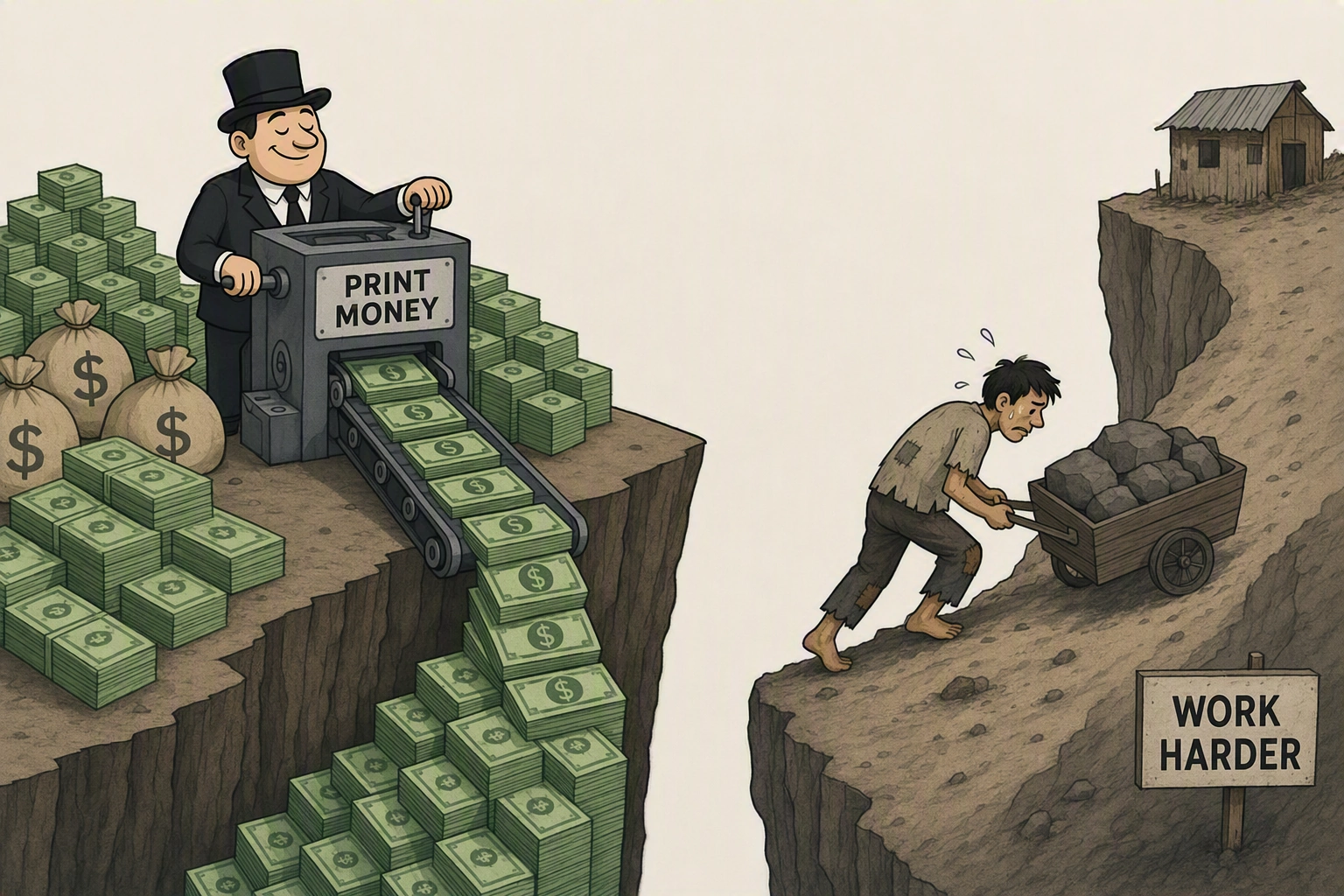
The Cantillon Effect turns inflation into a hidden tax. It robs wealth from the poor and middle class—who hold their savings in cash—and hands it directly to the wealthy, who own the assets that go up in price.
5. Triffin’s Dilemma: The Global Trap
The corruption of fiat money does not stop at national borders. Because the United States Dollar is the world’s reserve currency, the flaws of the fiat system are exported to every single country on Earth.
To understand how this harms the world, we must look at an economic paradox known as Triffin’s Dilemma, discovered by economist Robert Triffin in the 1960s.
The Conflict of Global Money
As the global reserve currency, the US Dollar is used for international trade, oil purchases, and foreign banking reserves. For global trade to run smoothly, the rest of the world needs a constant supply of US Dollars.
To give the world those dollars, the United States must consistently buy more goods from foreign countries than it sells to them. This creates a permanent trade deficit. The US exports paper dollars and imports real goods like cars, electronics, and oil.
United States ───[Prints Paper Dollars]───► Rest of the World
United States ◄───[Sends Real Goods]─────── Rest of the World
This dynamic creates an impossible paradox:
- Keep Printing: If the US keeps running massive deficits to supply the world with dollars, it will eventually print too much money and ruin its own currency’s value.
- Stop Printing: If the US stops running deficits to protect the value of the dollar, the global economy will freeze up because there will not be enough dollars to facilitate international trade.
The Corruption of Imperial Privilege
Triffin’s Dilemma grants the United States an “exorbitant privilege.” The US can spend far beyond its means, print money to cover its tracks, and force foreign nations to absorb the resulting inflation. Foreign citizens work hard to produce physical goods, only to trade them for paper notes that the US can generate instantly.
Eventually, this system becomes unstable. It forces nations into a game of financial musical chairs, where everyone knows the music will eventually stop, but no one can afford to sit down first.
6. Real-World Corruptions: Historical Fiat Collapses
When economists talk about the dangers of fiat money, they are not speaking in hypotheticals. History is littered with the corpses of paper currencies that printed themselves into extinction. Modern history gives us terrifying proofs of how fiat money corrupts and destroys societies.
Zimbabwe (2007–2008)
The most infamous modern example of fiat hyperinflation happened in Zimbabwe. Following severe economic mismanagement and the collapse of local farming, the government found itself deeply in debt. Instead of cutting spending, the Reserve Bank of Zimbabwe chose to print money to fund government operations.
- The Peak: By November 2008, Zimbabwe’s monthly inflation rate peaked at an unimaginable 79.6 billion percent.
- The Reality: Prices were doubling every 24.7 hours.
- The Absurdity: The government printed a $100 trillion banknote. This single piece of paper could not even buy a local bus ticket. Citizens abandoned the currency completely, turning to the black market and foreign cash to survive.
Yugoslavia (1992–1994)
As Yugoslavia began to break apart in the early 1990s, the regional economy fractured, and tax revenues plummeted. To fund a massive military, police force, and bloated bureaucracy, the government turned its money printing machines on full blast.
- The Peak: In January 1994, monthly inflation hit 313 million percent.
- The Reality: Daily inflation was 62%, meaning prices increased by roughly 2% every single hour.
- The Social Cost: Store owners stopped writing prices on items because they changed too fast. Citizens rushed to convert their local currency into German Marks immediately upon being paid, or watched their life savings turn into useless kindling by sunset.
Venezuela (2016–2019)
Despite possessing some of the largest oil reserves on the planet, Venezuela became a textbook example of fiat corruption in the 2010s. The government relied heavily on oil revenues to fund vast state programs. When oil prices crashed, the central bank began printing money relentlessly to cover its spending gaps.
- The Peak: The Central Bank of Venezuela officially calculated that inflation jumped over 53,000,000% between 2016 and 2019.
- The Reality: By 2018, prices were doubling every 19 days.
- The Humanitarian Cost: The national currency, the Bolívar, lost 99% of its value, effectively wiping out pensions and salaries. Citizens were forced to weigh paper cash on scales instead of counting it because the individual bills were worth less than the paper they were printed on.
7. The Human Cost: A Corrupted Society
The corruption of fiat money is not just an abstract problem for academic textbooks. It actively reshapes human behavior and breaks down the moral fabric of daily life.
The Death of Savings
When money holds its value, people save for the future. They sacrifice short-term pleasures today so they can build a better life tomorrow. This long-term thinking is the foundation of civilization.
Fiat money completely destroys this incentive. When inflation eats away your savings every year, keeping cash in a bank account is financial suicide. The fiat system forces you to become a consumer or a gambler. You must spend your money today before it loses its value, or risk your savings in a volatile stock market just to keep pace with inflation.
The Expansion of Government
Because fiat money allows governments to finance themselves without immediate taxation, it removes the natural checks and balances on state power. Politicians can fund endless foreign wars, construct wasteful projects, and buy votes with expensive social programs without ever having to justify the immediate cost to taxpayers. A government with a printing press is a government that answers to no one.
8. The Clear Red Line: From Printing Press to Inequality
When we step back and trace the path of fiat money, we can see a clear red line connecting every part of this broken machine.
[Fiat System Creation]
        │
        ▼
[Central Bank Over-Printing]
        │
        ▼
[Fractional Bank Multiplier]
        │
        ▼
[Insiders Benefit First (Cantillon Effect)]
        │
        ▼
[Global Instability (Triffin's Dilemma)]
        │
        ▼
[Massive Wealth Inequality & Social Decay]
The system begins with the choice to abandon honest, scarce money in favor of paper currency backed by nothing. Once that boundary is crossed, central banks gain the power to print money at will, and commercial banks use fractional reserves to multiply those debts even further.
Because this new money enters the economy through elite financial channels, the Cantillon Effect ensures that the wealthy accumulate hard assets while regular citizens watch their purchasing power disappear. On the global stage, Triffin’s Dilemma forces the entire world to participate in this unstable cycle.
The end result is an economic landscape defined by historic wealth inequality, shrinking middle classes, and volatile markets.
Summary of Key Terms
| Term | Simple Definition |
|---|---|
| Fiat Money | Money that has value only because a government says so. It has no physical backing. |
| Central Bank | The government-approved institution that controls a nation’s money supply. |
| Fractional Reserve | A banking method where banks keep a small fraction of deposits and lend out the rest. |
| Cantillon Effect | The rule that those closest to the money printer benefit, while those furthest away suffer. |
| Triffin’s Dilemma | The conflict where a global reserve currency must run deficits, eventually destroying itself. |
Conclusion: The Need for Honest Money
Fiat money is corrupt because it breaks the most fundamental rule of commerce: wealth must be earned through production, not created by permission.
When a small group of people can print money out of thin air, they possess a power that will always lead to corruption. It distorts prices, rewards financial gambling, punishes honest savers, and creates a massive gap between the rich and the poor.
A fair society requires a fair system of money. Until the world returns to a currency that cannot be manipulated, printed, or debased by a political elite, the paper illusion will continue to siphon wealth from the people who work for it, and hand it to the people who control it.
References
- Hanke, S. H., & Kwok, A. K. F. (2009). On the Measurement of Zimbabwe’s Hyperinflation. ResearchGate.
- International Monetary Fund (IMF). (2009). Public Information Notice: IMF Executive Board Concludes Article IV Consultation with Zimbabwe. IMF Official Site.
- Petrović, P., Bogetić, Ž., & Vujošević, Z. (1999). The Yugoslav Hyperinflation of 1992-1994: Causes, Dynamics, and Money Supply Mechanics. Yaroslavvb Papers.
- Cato Institute. (2007). The World’s Greatest Unreported Hyperinflation (Yugoslavia). Cato Institute Commentary.
- Central Bank of Venezuela. (2019/2020). Official Consumer Price Index and Inflation Data Releases. Cited via Reuters Report.
- Investopedia. (2026). Fiat Money Explained: Benefits, Risks, and Global Examples. Investopedia.