You work hard for your money. But where should that money be stored to store value or go to grow?
This is a question people have asked for thousands of years.
Today, you have more choices than ever before. You can buy gold, stocks, real estate, or even Bitcoin. Each one works in a different way. Each one has good points and bad points.
This article will look at all four options. We will see how they have done over time. We will look at the risks. We will look at the rewards. By the end, you will have a better idea of where your money might fit best.
Let us start with the oldest form of money we still use today.
Gold: The Ancient Store of Value
Gold has been valuable for over 5,000 years. Ancient kings loved it. Modern governments still hold it. Why? Because gold has some special properties which makes it appropriate to store value over time.
How Gold Has Performed
Over the very long term, gold has done one job well. It keeps your buying power. A gold coin from Roman times could buy a nice toga. Today, that same gold coin could buy a nice suit. The value in real goods stays about the same.
But gold does not grow. An ounce of gold is still just an ounce of gold. It does not pay you interest. It does not create new wealth. It just sits there, looking shiny.
In numbers, gold has gone from about $35 per ounce in 1971 to over $2,000 per ounce in recent years. That sounds great. But when you adjust for inflation, the real return is much smaller. From 1971 to 2024, gold has returned about 7.7% per year on average. But a lot of that came in a few short bursts.
The Good Side of Gold
- It is hard to produce new gold. The stock-to-flow ratio shows its very hard to inflate the gold supply.
- It is sovereign – You can hold it in your hand. No bank or government can delete it with a keystroke.
- It is resistent to time decay Every country values gold. You can sell it almost anywhere.
- It is well known and can be accepted worldwide. When wars, pandemics, or market crashes happen, gold often goes up.
- It is semi-portable You do not need to understand business to own gold.
The Bad Side of Gold
- It does not produce income. No dividends. No rent. No interest.
- It is very hard or expensive to verify. If you buy a gold bar, its nearly impossible to know if its 100% gold. For example, tungsten has almost identical density.
- It is hard or expensive to store safely. Big gold bars need vaults and security which
- It is hard to transport big amounts. It´s a heavy metal.
- It is impossible to send real gold digital. You can send certificates digital but the real commodity needs real physical transport which takes time.
- It can be confiscated.
Who Gold Is Best For
Gold is best for people who want safety. It is for people who worry about the financial system. It is not for people who want their money to grow fast.
Stocks: The Growth Engine
When you buy a stock, you buy a small piece of a real business. That business makes products, sells services, and earns profits. Over time, good businesses grow. Their profits grow. Their stock prices go up. And many of them pay you dividends along the way.
How Stocks Have Performed
The US stock market has returned about 10% per year on average since 1926. That includes dividends. This is the best long-term record of any major asset class.
But the ride is bumpy. Stocks can drop 20%, 30%, or even 50% in a bad year. The crash of 1929 took over 20 years to recover. The crash of 2008 took about 5 years. The COVID crash of 2020 took only months.
The key to stocks is time. If you hold for 20 years or more, stocks have almost always beaten every other asset class. But if you need your money next year, stocks can be very risky.
The Good Side of Stocks
- They grow your wealth. Businesses create real value. That value compounds over time.
- They pay income. Dividends give you cash while you hold the stock.
- They are liquid. You can sell a stock in seconds during market hours.
- They are easy to start with. You can buy stocks with very little money through index funds.
- They have tax advantages. Long-term capital gains are taxed lower than regular income in many places.
The Bad Side of Stocks
- They are volatile. Prices swing up and down every day. This can be scary.
- Businesses can fail. A single stock can go to zero. This is why diversification matters.
- They depend on the economy. In a deep recession, most stocks drop together.
- They require patience. If you panic and sell during a crash, you can lose a lot of money.
- They compete against each other and the technology advancement.
Who Stocks Are Best For
Stocks are best for people with a long time horizon. If you are young and can wait 10 to 30 years, stocks are hard to beat. They are also good for people who want their money to work hard and grow.
Real Estate: The Tangible Investment
Real estate is land and the buildings on it. People always need places to live, work, and shop. Real estate can give you rental income and price growth at the same time.
How Real Estate Has Performed
US residential real estate has returned about 3.8% per year on average since 1926. That is much less than stocks. But that number does not tell the whole story.
When you buy real estate with a mortgage, you use leverage. If you put 20% down and the property goes up 5%, your return on your cash is 25%. This leverage makes real estate much more powerful than the raw numbers suggest.
Also, rental income adds to your returns. After expenses, rental yields are often 3% to 8% depending on the market.
The Good Side of Real Estate
- It produces income. Rent comes in every month.
- You can use leverage safely. A mortgage lets you control a big asset with a small down payment.
- It has tax benefits. In many countries, you can deduct mortgage interest and depreciation.
- It is tangible. You can see it, touch it, and improve it with your own work.
- It is inflation-resistant. Rents and property values tend to rise with inflation.
The Bad Side of Real Estate
- It takes a lot of money to start. A down payment is usually thousands or tens of thousands.
- It is not liquid. Selling a house takes weeks or months.
- It requires work. Tenants call at night. Toilets break. Roofs leak.
- It is concentrated risk. One property in one city is not diversified.
- Transaction costs are high. Buying and selling real estate involves big fees and taxes.
Who Real Estate Is Best For
Real estate is best for people who want monthly income and are willing to put in work. It is also good for people who like leverage and tax benefits. It is not for people who want easy, hands-off investing.
Bitcoin: The New Kid on the Block
Bitcoin was created in 2009. It is the newest asset class we will discuss. It is digital money that no government controls. It runs on a network of computers around the world.
How Bitcoin Has Performed
Bitcoin has been the best-performing asset in history over short periods. It went from less than a penny in 2009 to over $69,000 in 2021. But the ride is extremely wild.
Bitcoin has dropped 70% to 80% multiple times. In 2011, it dropped 93%. In 2018, it dropped 84%. In 2022, it dropped 77%. These crashes are brutal. But so far, Bitcoin has always recovered and gone on to new highs.
Because Bitcoin is so new, we only have about 15 years of data. This makes it hard to compare to gold, stocks, or real estate, which have decades or centuries of history.
The Good Side of Bitcoin
- It is scarce. There will only ever be 21 million bitcoins. No one can print more.
- It is global and digital. You can send it anywhere in the world in minutes.
- It is easy to store. You can hold billions of dollars on a small device or even in your head.
- It is independent. No government or bank controls Bitcoin.
- It has grown fast. Early investors have made huge returns.
The Bad Side of Bitcoin
- It is extremely volatile. Price swings of 10% in a day are common.
- It has no income. Like gold, Bitcoin pays no dividends or rent.
- It is still risky. Governments could ban it. Technical problems could happen. Better technology could replace it.
- It is hard to understand. Many people do not trust what they cannot touch or fully grasp.
- It uses a lot of energy. The Bitcoin network consumes as much electricity as some small countries.
Who Bitcoin Is Best For
Bitcoin is best for people who can handle extreme risk. It is for people who believe in digital money and decentralization. It is not for people who need safety or steady income.
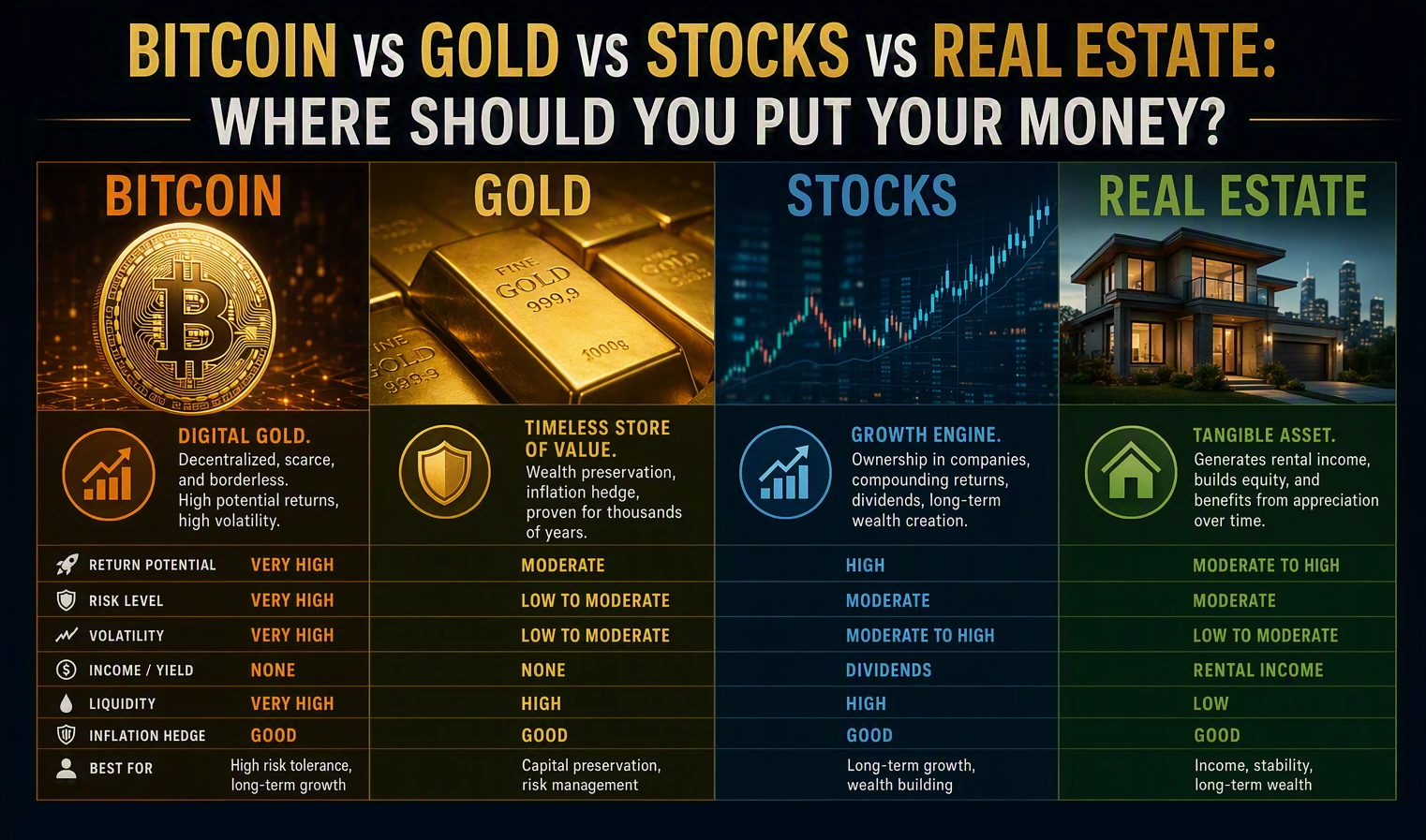
Head-to-Head Comparison
Now let us compare all four side by side on the things that matter most.
Returns Over Time
| Asset | Average Annual Return | Time Period |
|---|---|---|
| Stocks | ~10% | Since 1926 |
| Real Estate | ~3.8% (without leverage) | Since 1926 |
| Gold | ~7.7% | Since 1971 |
| Bitcoin | ~100%+ | Since 2009 |
Important note: Bitcoin’s returns are not sustainable at that rate. As an asset grows, its growth rate naturally slows down. Bitcoin will not keep doubling forever.
Stocks win on long-term returns. But Bitcoin has crushed everything in its short life. Gold and real estate are in the middle.
Risk and Volatility
Risk is not just about losing money. It is also about how much prices swing.
| Asset | Volatility Level |
|---|---|
| Gold | Medium |
| Stocks | Medium-High |
| Real Estate | Low-Medium |
| Bitcoin | Extremely High |
Bitcoin is by far the most volatile. Real estate is the least volatile because you do not get a price quote every day. This makes real estate feel safer, even though it can still lose value.
Liquidity
Liquidity means how fast you can turn your investment into cash.
| Asset | Liquidity |
|---|---|
| Stocks | Very High |
| Bitcoin | High |
| Gold | Medium-High |
| Real Estate | Low |
Stocks win here. You can sell them in seconds. Bitcoin is also fast. Gold takes a little more effort. Real estate can take months.
Barriers to Entry
How much money and knowledge do you need to start?
| Asset | Minimum to Start | Knowledge Needed |
|---|---|---|
| Stocks | Very Low | Low |
| Bitcoin | Very Low | Medium |
| Gold | Low | Low |
| Real Estate | High | High |
Stocks and Bitcoin are the easiest to start. You can buy fractional shares with just a few dollars. Real estate requires the most money and knowledge.
Income Generation
| Asset | Regular Income? |
|---|---|
| Real Estate | Yes (rent) |
| Stocks | Yes (dividends) |
| Gold | No |
| Bitcoin | No |
If you need cash flow, real estate and dividend stocks are your best options. Gold and Bitcoin do not pay you anything.
Inflation Protection
| Asset | Inflation Protection |
|---|---|
| Gold | High |
| Real Estate | High |
| Stocks | Medium |
| Bitcoin | Unknown |
Gold and real estate have long track records of keeping up with inflation. Stocks can too, but companies can be hurt by rising costs. Bitcoin is too new to be sure, but its fixed supply makes it promising.
What History Teaches Us
Looking back at history gives us some clear lessons.
Lesson 1: Time is your best friend with stocks. The longer you hold stocks, the better they tend to do. Short-term drops fade away over decades.
Lesson 2: Gold shines in dark times. When people are scared, gold goes up. It is insurance, not a growth engine.
Lesson 3: Real estate builds wealth slowly but surely. Leverage and rental income make real estate powerful. But it takes patience and effort.
Lesson 4: Bitcoin is a wild card. It could keep growing massively. It could also fail. No one knows for sure.
Lesson 5: Diversification wins. The best investors do not put all their money in one thing. They spread it across different assets.
Which Is Right for You?
There is no single best answer. It depends on your goals, your age, your risk tolerance, and your situation.
If You Are Young with a Long Time Horizon
Consider mostly stocks and some Bitcoin. You have time to recover from crashes. Growth is your friend.
If You Want Monthly Income
Look at real estate and dividend stocks. These pay you regularly. Gold and Bitcoin do not.
If You Fear Economic Collapse
Gold is your best bet. It has survived every crisis in history. Bitcoin might also work, but it has never been through a true global depression.
If You Want Easy, Hands-Off Investing
Stock index funds are the simplest choice. You can set up automatic investments and forget about them.
If You Believe in Digital Money
Bitcoin might deserve a small part of your portfolio. But never put in more than you can afford to lose completely.
A Balanced Approach
Many smart investors use a mix of all four. Here is one example:
- 50% Stocks for long-term growth
- 20% Real Estate for income and inflation protection
- 15% Gold for crisis insurance
- 15% Bitcoin for high-risk, high-reward potential
This is just one example. Your mix should fit your own needs and comfort level.
Final Thoughts
Gold has worked for 5,000 years. Stocks have created the most wealth over the last century. Real estate has built fortunes with leverage and patience. Bitcoin is a new experiment with amazing potential and real risks.
None of them is perfect. All of them have a place in the investing world. The worst thing you can do is nothing at all. Inflation eats your money if you just keep it in cash.
The best thing you can do is start learning, start small, and think long-term. Your future self will thank you.